Red wine · Bruñal and Mencía
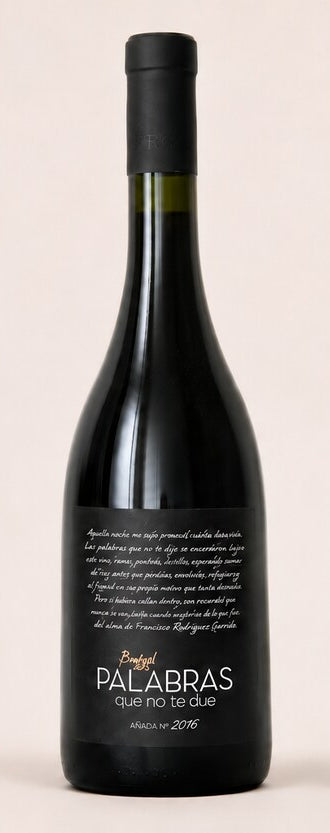
Palabras que no te dije
Bruñal and Mencía from centenarian, ungrafted vines. The wine through which we recount the story of a promise.
Vintages
Choose the year shown on the label.2016 · Harvest context in the region
A warm and dry September
September was warm and dry in Castilla y León, punctuated by a period of rainfall mid-month. In certain municipalities of Arribes within Salamanca, harvest commenced between late September and early October.Palabras que no te dije 2016 was awarded 91 points in the 2025 Peñín Guide tasting.
View the 2016 vintage in the shop →2015 · Harvest context in the region
The summer heat defined July
July was dry and exceptionally warm across much of Castilla y León. The harvest summary for Arribes highlighted that, throughout the campaign, conditions favored optimal ripening.Palabras que no te dije 2015 was awarded 92 points in the 2021 Peñín Guide.
View the 2015 vintage in the shop →2014 · Harvest context in the region
Rainfall altered the calendar
The growing cycle in Arribes had been progressing earlier than the previous year. September rains prompted several wineries across the region to postpone the scheduled harvest. View the 2014 vintage in the shop →Tasting notes
Serving temperature: 18–20 ºC.
Technical sheet
Vineyard and harvest
Grape varieties
This wine is as singular as the grapes from which it is born.
Bruñal, the emblematic variety of Arribes del Duero and our vineyards, is entirely unique in the world. Yielding medium-high vigor, low yields, and limited production, it lends remarkable firmness and personality. It is distinguished by its substantial tannic structure—derived from the thorough lignification of stems and seeds—as well as its polyphenolic concentration and profound fruit intensity.
Mencía, cultivated in venerable, ungrafted vineyards and deeply shaped by the terroir, develops organoleptic nuances distinct from those it exhibits in other regions.
Harvest
The blend of this wine is predominantly composed of Bruñal and Mencía.
Crafted from carefully selected grapes harvested from centenarian, ungrafted, pre-phylloxera vines. Their agronomic and enological character gracefully supports extended aging in French oak and in bottle.
Vineyard origin
Location: Villalcampo, Arribes del Duero Natural Park (Zamora, Spain)
Altitude: 800 meters above sea level
Geographic origin: Arribes del Duero
Climate
A privileged enclave shaped by a Mediterranean microclimate:
- Mild, brief winters with minimal frost.
- Long, warm summers.
The diurnal temperature variation promotes balanced grape development, achieving deep aromatic concentration and optimal ripeness.
Soil
Slate loam with a quartzitic composition.
The landscape's sheeted granite and steep slopes regulate moisture with natural precision, draining excess water during rainy springs.
Training system
Trained in the traditional bush-vine (goblet) system, without trellising or artificial support.
Low yield per vine, allied with varietal purity, yields fruit of exceptional distinction.
Harvest
Hand-harvested, guided by the steep slopes of the vineyards and a rigorous selection of only the finest clusters.
The harvest date is determined by meticulous monitoring of phenolic ripeness, seeking the precise moment that unlocks maximum aromatic expression.